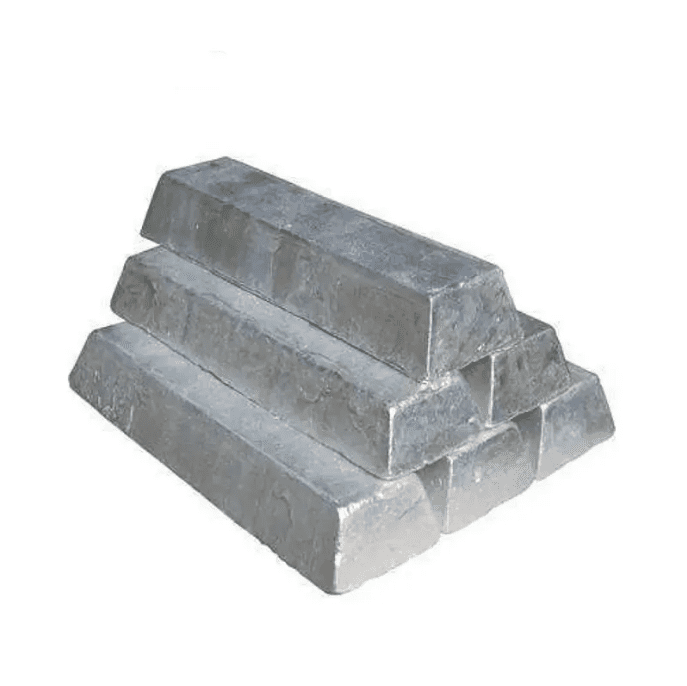
Antimony Ingots
Antimony Ingots have high corrosion and oxidation resistance and are ideal for conducting various chemical processes
Introduction
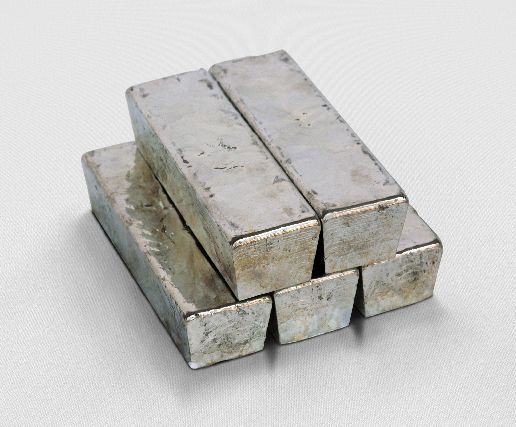
Antimony ingots are metallic blocks composed primarily of antimony, a metalloid element. They are used in various industrial applications, particularly as an alloying agent to enhance the properties of other metals, such as lead, making them stronger and more durable. Antimony ingots also serve as a raw material for producing antimony compounds, which have diverse applications in industries like flame retardants, batteries, and ceramics
Key Properties and Uses
Alloying
Flame Retardants
Batteries
Other Uses
Everything you need Know
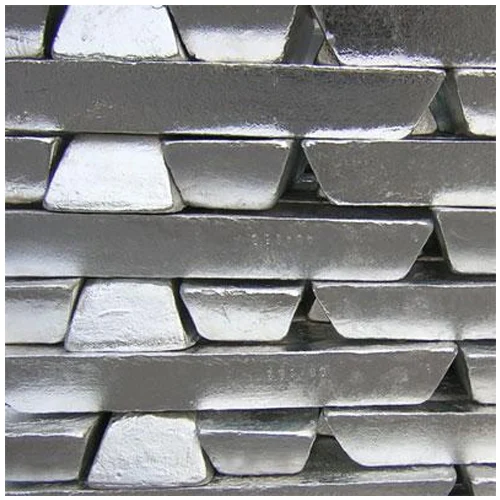
Antimony is non-ferrous metals, metal antimony appearance is silvery white, hexagonal system, the melting point is 630.5 ℃, mohs hardness 3, density of 6.69 g/cm3, it is poor conductor of heat and electricity. Antimony is brittle, easy to grind, no ductility. Not easy reacting with air or oxygen at room temperature. Antimony is insoluble in water and generally does not react with acids.
Grade & Specification:
Grade | Sb-00 | Sb-0 | Sb-1 | Sb-2 | |
Sb % Min | 99.95 | 99.9 | 99.85 | 99.65 | |
Chemical composition % Max. | As | 0.01 | 0.03 | 0.05 | 0.1 |
Pb | 0.01 | 0.05 | 0.1 | 0.2 | |
Fe | 0.003 | 0.01 | 0.015 | 0.02 | |
Cu | 0.003 | 0.01 | 0.01 | 0.015 | |
Se | 0.0015 | 0.003 | 0.004 | 0.005 | |
Bi | 0.003 | 0.005 | 0.01 | 0.03 | |
Cd | 0.0005 | 0.001 | 0.001 | 0.0015 | |
Te | 0.0015 | 0.003 | 0.005 | 0.005 | |
S | 0.005 | 0.008 | 0.04 | 0.06 | |
Sn | 0.0015 | 0.003 | 0.003 | 0.003 | |
Tomorrow’s battery, available today.
AGM batteries offer superior performance, with a glass mat separator that delivers up to twice the life of standard flooded batteries and unprecedented energy output even in the most demanding conditions.